
Haskell Projected Versus Actual Release
TDCJ defines Projected Release Date as a Classification and Records calculation of when an incarcerated person is expected to leave if parole does not occur sooner. It is forward-looking. Offense rules, sentence data, good-conduct treatment, mandatory-supervision eligibility, and Board action can affect the calculation. Parole eligibility is different: it marks when the Board may consider release, not when release must happen.
A Scheduled Release date and location can appear after TDCJ receives a release certificate, audits the file, and arranges the event. TDCJ says that processing generally takes about 14 to 21 business days, yet the date can change without notice, even on the named day. An actual release or discharge is a completed historical event shown by the custodian’s record.
Pretrial custody has a different logic. A person awaiting a Haskell County case does not have a sentence-based projected date. Bond, court orders, a detainer, dismissal, plea, or transfer may control what happens next. A court order gives legal authority, while the sheriff’s register or release sheet shows when the movement occurred.
Find Haskell Projected Release Dates
The correct route depends on whether the person is in county, state, federal, or immigration custody. The Haskell County Sheriff page has no online roster or projected-date tool. TDCJ’s live search is useful only while a person remains incarcerated in the state system.
- Confirm identity with full name, birth date, booking or cause number, or a TDCJ/SID number.
- Ask which agency has legal custody. Physical placement at Rolling Plains does not answer that question.
- For a current state prisoner, open the TDCJ inmate search, match identifiers, and record the Projected Release Date, parole fields, maximum expiration, unit, and any Scheduled Release fields.
- For a county sentence, obtain the judgment and jail-credit terms from the correct Haskell clerk, then ask the Sheriff for the agency’s calculation and release or transfer record.
- After the date passes, request actual history from TDCJ or the sheriff. Do not turn a missing live result into a release conclusion.
The TDCJ search asks for exact last name and at least a first initial, or a TDCJ or SID number; gender and race can narrow a match. It updates on working days and is at least 24 hours old. Its detail can show offense, conviction county, location, projected date, parole review, and scheduled-release information for a current inmate.
The TDCJ inmate-information channel accepts a full name and seven-digit TDCJ number. If that number is unknown, send the exact birth date or approximate age and conviction county. For a completed event, ask specifically for incarceration, release, or discharge history rather than only the old projection.
The official TDCJ search screen below shows the current-custody scope and search route.
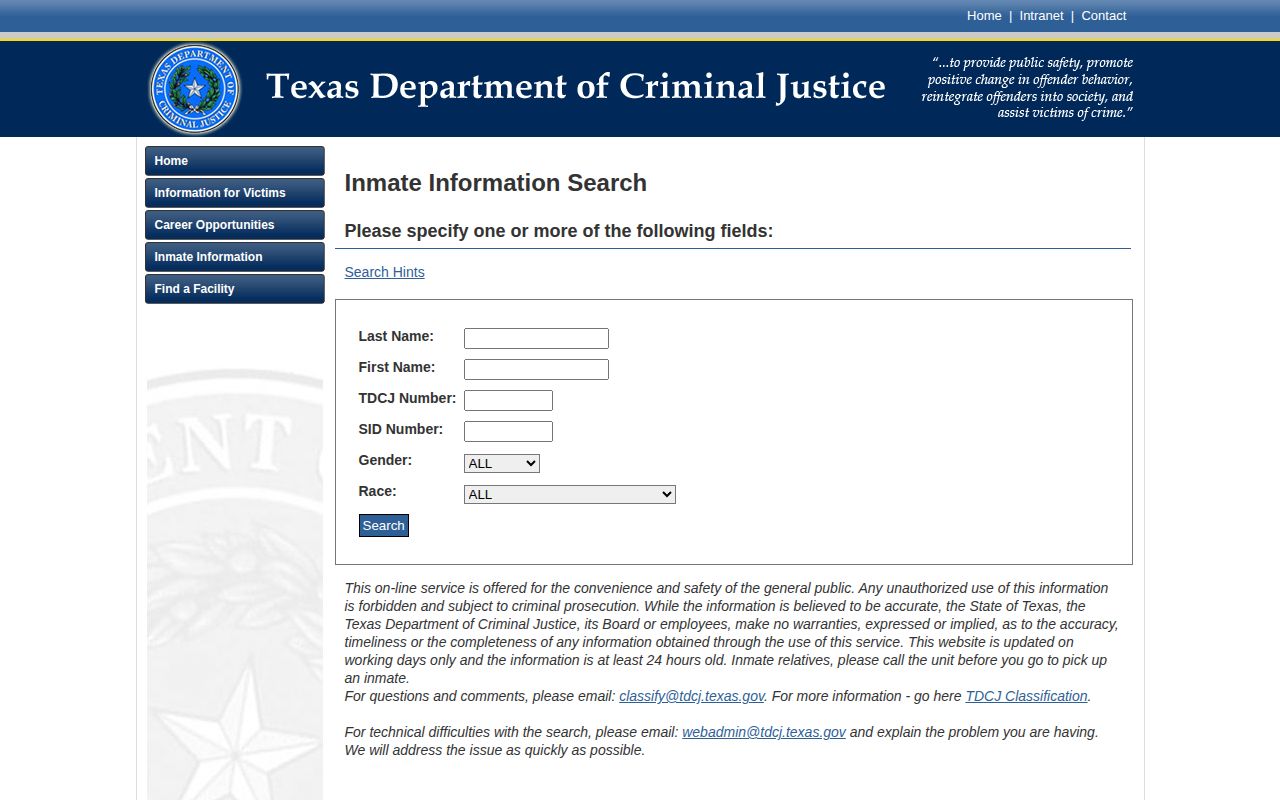
Its warning is central: a person who has fully left TDCJ normally drops from this live database.
Texas Good Time and Haskell Release
Texas good conduct is not a fixed discount from every prison term. Government Code Chapter 498 establishes classifications and awards. Section 498.003(d) permits up to 15 added days for each 30 days actually served for diligent work or participation in listed agricultural, educational, or vocational programs. The effect depends on the governing offense and release framework.
For mandatory-supervision-eligible offenses before September 1, 1996, TDCJ explains that flat time plus good time reaching the sentence can control. For eligible offenses on or after that date, discretionary mandatory-supervision review matters. A Board denial can move the projection toward maximum expiration; later approval can bring it forward. Ineligible cases generally project to maximum expiration unless parole occurs.
Good time can affect eligibility or mandatory-supervision calculations without guaranteeing release. Parole remains a Board decision. A favorable vote may include a treatment or program condition that must be completed first. TDCJ audits the record after a release certificate arrives, so the public date can change as sentence and program facts are reconciled.
Why Haskell Release Dates Change
A date can move earlier or later for several record-based reasons. The person’s file, not a general rule, identifies the actual cause.
| Factor | Possible effect |
|---|---|
| Jail credit or identity correction | Changes the time calculation when prior custody or record data is corrected. |
| Good-conduct change | May alter an eligible calculation after an award, classification change, or disciplinary loss. |
| Detainer or warrant | May cause transfer to another authority instead of community release. |
| Board action | Approval, denial, later review, or a program condition can alter the expected path. |
| Court order | An amended judgment, sentence, bond order, or revocation can change custody authority. |
| Release plan or program | Approval and completion requirements can affect scheduling after a favorable vote. |
A detainer is another agency’s request or legal basis to hold or receive the person. It can turn departure from one facility into a transfer. At Rolling Plains, movement may involve Haskell County, ICE, USMS, or another county, so the destination custodian must be identified. The receiving authority’s record then controls the next custody step.
Note: TDCJ warns that a scheduled date may change on the date itself, so confirm the event after processing.
Confirm Haskell County Release
For a Haskell county-jail event, call the Sheriff’s Office at 940-864-2345 and request the jail-register entry plus the booking-out, release, or transfer sheet. Ask for date and time, release authority, event type, and publicly releasable destination. The permanent register distinguishes release from transfer. Match it to the bond order or judgment from the correct clerk.
For state custody, use TDCJ IVSS for continuing parole or mandatory supervision and make a focused TDCJ information or Public Information Act request for actual release or discharge history. The Haskell County VINELink inmate search route explains the split between county IVSS and TDCJ IVSS notifications.
A notification can be quick, but the agency history is stronger. Save the projected and scheduled fields before they disappear from a current-custody search, then reconcile them with the completed event. A parole record can show that prison custody ended into supervision. Full discharge means state sentence authority has ended.
No Blanket Texas 85 Percent Rule
Texas does not impose a blanket rule that every state prisoner must serve 85 percent. Importing that federal-style figure produces a bad Haskell projected release date. Texas calculations turn on offense date, offense type, mandatory-supervision eligibility, Board action, and maximum expiration.
Government Code Chapter 508 contains the controlling parole and mandatory-supervision framework. Section 508.145 includes special serious-offense provisions in which actual calendar time must equal one-half of the sentence or 30 calendar years, whichever is less. Good conduct does not reduce that flat-time threshold. Sections 508.147 through 508.149 govern mandatory supervision, exclusions, and discretionary review.
Eligibility is only the point when the Board may consider release. It does not show that a vote has occurred, that a release certificate has been issued, or that the person has left state custody. A favorable vote can require a program first. Once Classification and Records receives the certificate, TDCJ says its audit and scheduling process generally takes about 14 to 21 business days. A Scheduled Release date and location may then appear, but TDCJ warns that the plan can change without notice. Save that field with its date, then request the completed history after departure.
Haskell County jail sentences must not be run through the TDCJ formula. Read jail credit and sentence terms from the local judgment, then obtain the Sheriff’s calculation and completed record. No official Haskell weekend-advance practice, fixed daily release time, or local good-time policy was verified. Those facts must come directly from the jail and sentencing court.
- Projected date
- A changeable calculation of when custody may end.
- Scheduled date
- A processed plan after review and release preparation.
- Maximum expiration
- The end point of the sentence calculation absent an earlier lawful release.
- Parole eligibility
- The first point for possible Board consideration, not a promised release.
Haskell County Sentence Calculations
A county-jail sentence is calculated from the local judgment, commitment papers, jail credit, and any lawful local credit. TDCJ’s projected-date formula should not be copied onto that sentence. The Sheriff page does not publish a calculator, release hour, weekend policy, or local good-time rule. Ask the sentencing court for the operative order and the Sheriff for the calculation used in the booking record.
The Haskell District Clerk’s official contact is PO Box 27, Haskell, Texas 79521, and 940-864-2030. District felony records may include the judgment, sentence, credit, and later orders. County-level matters can be held by a different clerk. Give the cause number and filing year when possible, and ask which office is custodian rather than assuming one search covers all courts.
If a court grants bond or enters a time-served judgment, the order authorizes the next act but does not record completion of jail processing. Request the jail-register entry and release sheet as well. Texas retention schedule PS4200-06 makes the county register permanent and includes release or transfer date. PS4200-10 keeps the related packet for at least two years after the event.
Rolling Plains requires one more question: which authority held the person? A county prisoner, an ICE detainee, and a USMS prisoner can leave the same building through different legal paths. Movement to another site remains a transfer if legal custody continues. Use the sending county record, ICE ODLS or ERO, or the federal docket and USMS channel as appropriate.
The final timeline should name the source beside each date. Record the booking date, court action date, projected or scheduled date, and actual release or transfer timestamp as separate facts. That method exposes conflicts and avoids turning an estimate into a completed Haskell County release.
Public Record Search
Sponsored Results