
BOP Identity and Record Scope
The BOP locator’s 1982-to-present scope applies to federal inmates incarcerated during that period, not to every person ever arrested or detained on a federal matter. Some older records may contain data that was later updated after the Sentencing Reform Act, and the public display remains a locator rather than a full court or prison file. A no-result can mean the person was never committed to BOP, the identifying details differ, or the relevant custody belonged to USMS or another sovereign. Check the federal docket before assuming that a missing BOP record proves release.
Federal identifiers are much safer than a name alone. A BOP register number points to the prison record; a federal case number points to the court record. DCDC, FBI, and INS numbers are alternate locator inputs where known. When two people share a name, compare age, race, sex, register number, court district, and custody dates without reproducing more personal detail than needed. Save the returned wording exactly. `RELEASED`, `UNKNOWN`, a future date, and a current location are separate results and should never be blended into a generic release claim.
Federal Release Paths Near Haskell
The Federal Bureau of Prisons is a nationwide prison system. No BOP institution was verified inside Haskell County. A person can still have a Haskell connection through an arrest, court case, contract bed, family destination, or later supervision while serving a federal sentence elsewhere.
USMS and BOP roles must remain separate. USMS handles federal defendants from court-ordered custody through release or acquittal, or through conviction and delivery to BOP. BOP then holds people committed to the federal prison system. A departure from Rolling Plains under USMS authority is not automatically a BOP release.
Search BOP Federal Release Records
The official BOP inmate locator accepts BOP register, DCDC, FBI, or INS number. A name search can use race, sex, and age to narrow the match. Results cover federal inmates incarcerated from 1982 to the present.
- Use a known federal identifier whenever possible.
- Otherwise search the exact name and narrow by the available biographical fields.
- Match the register number, age, race, and sex before relying on the result.
- Read the date together with location or status, not in isolation.
- If the person was only in USMS pretrial custody, move to the docket and USMS route.
The locator can display name and register number, age, race, sex, release date, and location or status. Its historical strength makes it the first public source for a completed BOP event.
The BOP locator search is captured here to show the nationwide official entry point.
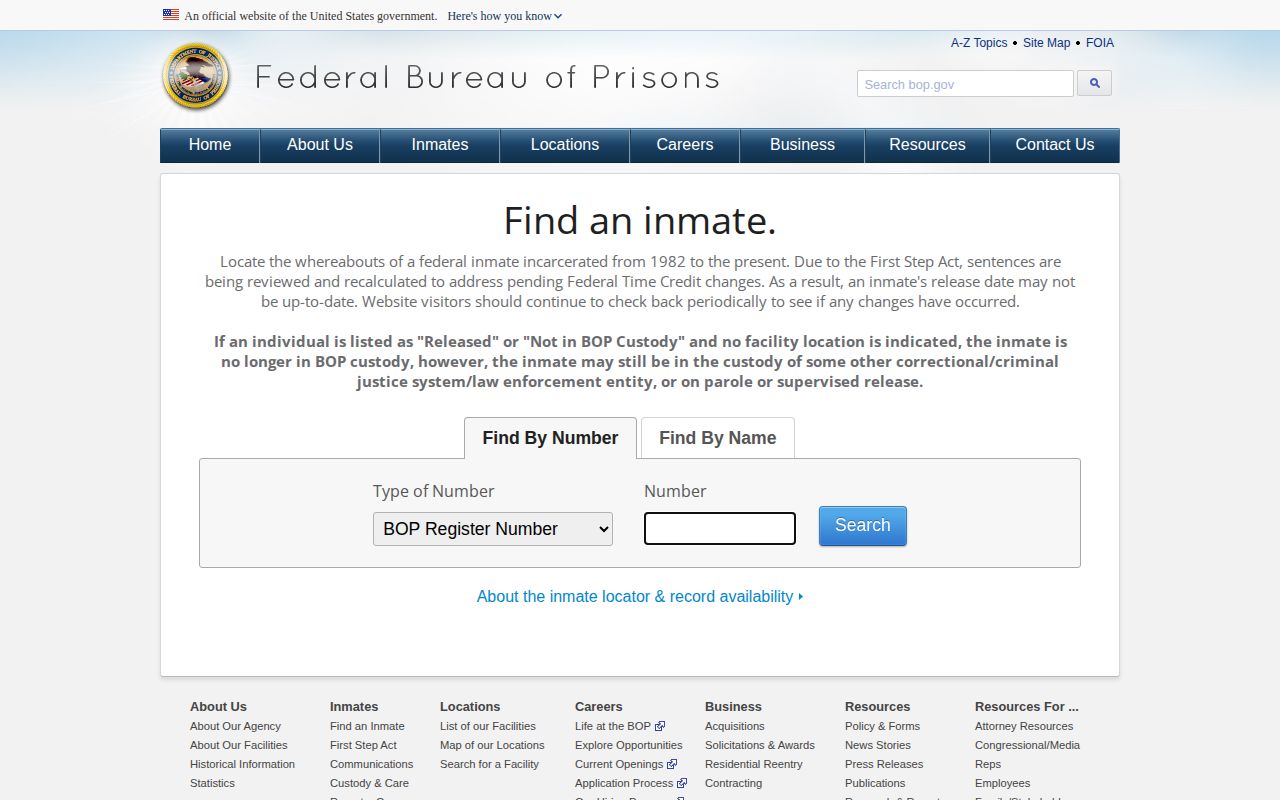
The image represents the BOP search interface, not proof that Haskell County contains a federal prison.
BOP Federal Release Field Meanings
A date must be read with the status label. The BOP record explanation says `RELEASED` means the person is no longer in BOP custody. `UNKNOWN` means the confinement term has not been determined. A future date is projected and may change.
| Display | Meaning |
|---|---|
| Past date with RELEASED | The person is no longer in BOP custody. |
| Future release date | A projected BOP date, not a completed departure. |
| UNKNOWN | The term of confinement is not determined. |
| Current location | The BOP institution or status shown at the time checked. |
| Register number | The key identifier for distinguishing people and requesting records. |
The official field guide is captured here because the status label changes the meaning of the date.
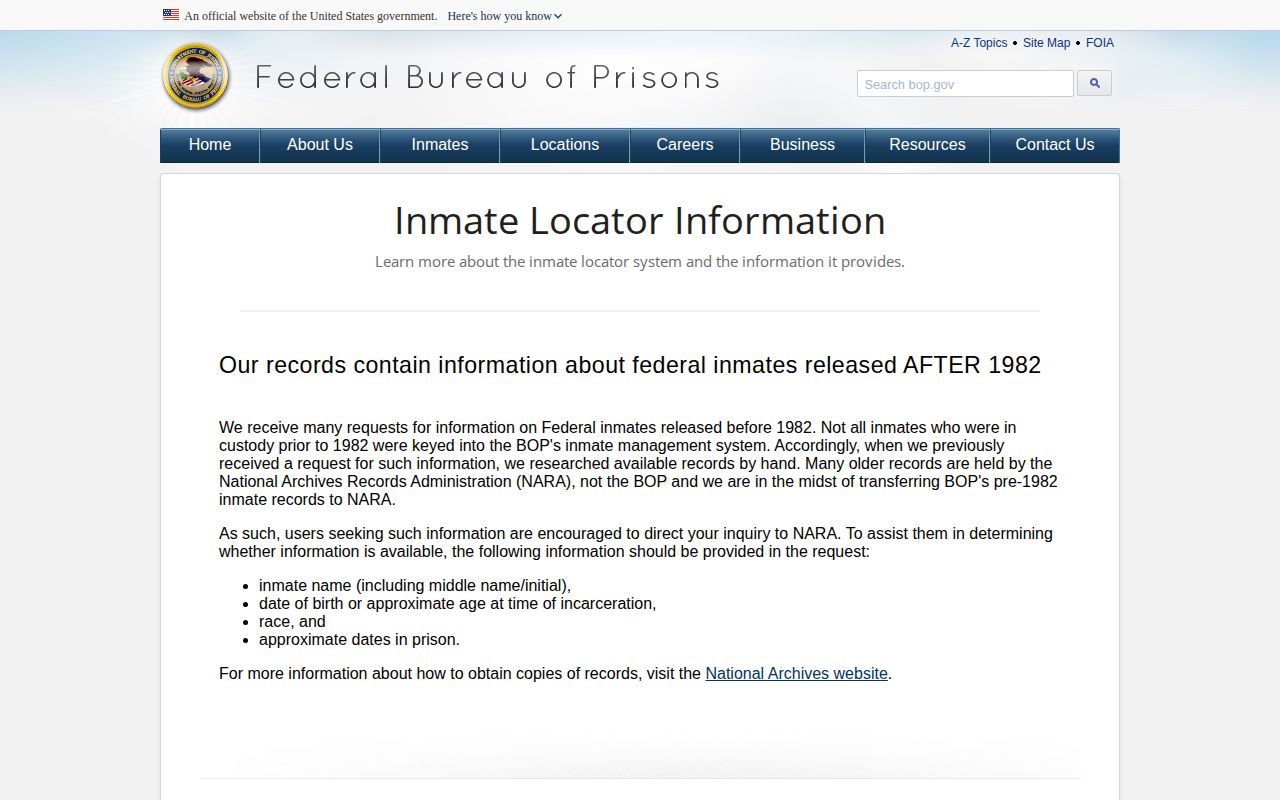
The captured definitions prevent a projected date or unknown term from being reported as an actual federal release.
What BOP Release Does Not Prove
A past BOP date with `RELEASED` confirms only that BOP custody ended. It does not rule out federal supervised release, federal parole where applicable, a state sentence, ICE custody, a new detention, or another sovereign’s hold. BOP statistics also distinguish releases from transfers to state or ICE custody.
Supervised release is a court-ordered period after imprisonment and is not the same as BOP incarceration. Its terms and completion belong to the federal court and probation record. If another authority took custody, follow that agency rather than treating the BOP event as return to the community.
USMS Pretrial Custody Records
The U.S. Marshals Service prisoner program manages federal defendants from court-ordered custody until acquittal or release, or conviction and delivery to BOP. It often uses state, local, or private contract beds. That is the relevant distinction at Rolling Plains when federal pretrial custody is involved.
USMS has no public released-inmate locator comparable to BOP. The federal docket and signed detention or release order are the first sources. The order explains authority but may not show the exact departure time. A focused records request can seek disposition or release fields, subject to Privacy Act and FOIA limits.
| Federal stage | Primary source |
|---|---|
| Pretrial detention | Federal docket, court order, and USMS. |
| Committed prison sentence | BOP locator and BOP records. |
| Post-prison supervision | Federal court and probation records. |
| Transfer to ICE or state | The receiving sovereign’s locator or records. |
Request a USMS Release Record
Begin with the federal case number, defendant’s full name, approximate custody dates, and any prisoner identifier. Obtain the public docket and release, detention, acquittal, sentencing, or commitment order first. Only then use the USMS FOIA channel for a narrow historical request.
- Identify the federal district and case number.
- Download or request the order that controlled detention or release.
- Determine whether the person remained with USMS or was committed to BOP.
- Request only the needed movement, disposition, or release fields from USMS.
- Expect redaction and do not ask USMS to certify BOP, ICE, or state custody.
The USMS Prisoner Tracking System contains prisoner-processing and population-management records, but the public does not receive unrestricted prisoner histories, photos, or arrival and departure details. A targeted request has a clearer scope than a demand for the entire file.
Rolling Plains Federal Transfers
Rolling Plains has historically housed USMS and ICE populations as well as county prisoners. The street address does not decide which federal record applies. Leaving the building for another USMS contract bed is a transfer. Delivery from USMS to BOP after conviction is also a transfer into the prison system, not release to the community.
If ICE receives the person, use the ICE Online Detainee Locator and ERO route. ICE says ODLS covers current custody and people released within the prior 60 days. A USMS-to-ICE handoff ends one custody episode while another continues.
The Rolling Plains custody page separates these authority layers in local detail. Do not infer current occupancy from an old inspection or archived facility listing.
Match Federal and Haskell Records
A county arrest record, a federal docket, a USMS movement, and a BOP locator result can describe successive events. Reconcile them with official identifiers and dates. A common name is not enough. The federal register number, case number, date of birth, and custody dates help prevent a false match.
The Haskell County released inmate search is the proper starting point when it is unclear whether the person left county custody for federal custody or returned to the community. Once commitment to BOP is confirmed, the BOP locator controls the public federal prison check.
- USMS
- The agency responsible for federal prisoner custody that commonly includes pretrial detention.
- BOP
- The federal prison system for committed inmates.
- Projected date
- A future estimate that is not an actual release.
- Supervised release
- Court-ordered supervision after imprisonment, outside BOP custody.
Verify Federal Release Status
Save the locator result, status label, and date checked. For a past `RELEASED` result, compare the federal docket for later supervision or custody orders. For `UNKNOWN`, do not assign a date. For a future date, label it projected.
If no BOP result appears, check spelling and identifiers, then determine whether the person was ever committed to BOP. A pretrial defendant may remain entirely within the court and USMS trail. Older or restricted movement facts may require a focused agency request. The strongest answer states exactly which custodian ended, when, and what authority or supervision followed.